Why we are here:

Our signature Bible passage, the prologue to John's Gospel, tells us that Jesus (the Logos) is God and Creator and that He came in the flesh (sarx) to redeem His fallen, sin-cursed creation—and especially those He chose to believe in Him.

Here in Bios & Logos we have some fun examining small corners of the creation to show how great a Creator Jesus is—and our need for Him as Redeemer. Soli Deo Gloria.

***

Sunday, April 12, 2009

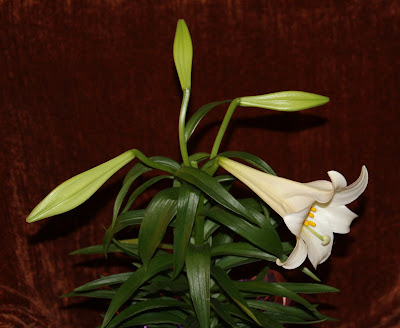
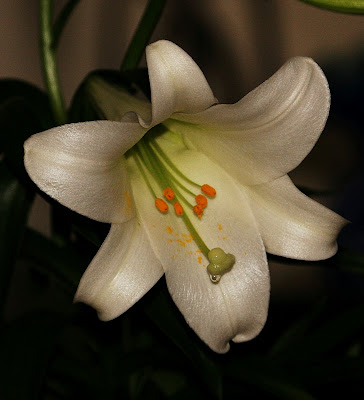
A lily is never quite enough!


In 1919, a World War I soldier brought a suitcase full of big flower bulbs home to Oregon and passed them out to his friends. They grew them. They liked the sweet smelling, pure white lilies and started cultivating them. The climate of the Oregon coast proved ideal for growing Lilium longiflorum, and by 1945 there were more than a thousand Easter lily growers up and down the west coast.

But it takes a lot of work and patience to grow the bulbs—three years of planting, culling, separating, fertilizing, replanting—not to mention forcing them to bloom at just the right time of year. So now, only about ten commercial growers produce most of the lilies that pop up in stores and nurseries for sale at Easter time.

These lilies have become almost synonymous with Easter, along with bunnies and eggs. While those symbols are of pagan origin, as is the name Easter (we should be calling it Resurrection Day), the pure white lily can at least offer some imperfect analogies to the meaning of Passion Week, the turning point in human history.

Let’s begin with the color—pure white. The lily’s whiteness comes from the refraction of light within its cells, which act as miniature lenses. But notice, from our photographs, that without the proper lighting, the blossom may appear dingy and brownish. In fact, nothing can compare with Christ’s pure, holy whiteness. As Christians, we are robed in the white robes of Christ’s righteousness, not our own; and the dinginess of our old fallen human nature lurks within until, by His grace, we are transformed into His likeness.

How about the flower’s three-part structure? As a monocot, the lily has its parts in threes or multiples of three. I suppose we can make an analogy to the mystery of the Trinity—but again, it would be an pitifully imperfect one. Any little illustration of the Trinity falls miserably short. We use little diagrams and comparisons, simply because our puny human minds cannot embrace the concept of Holy God, one in being and essence, three in persons—let alone the hypostatic union: Jesus Christ as fully God and fully man, one in person. We believe in God on the high order of Trinity because His Word teaches it in so many ways.

As I write, here in my “man cave”, the fragrance of the Easter lily wafts in from the living room. The flowers are pumping out complex volatile molecules called terpenoids, their odor now diffusing throughout space. It’s a pleasant perfume, but one plant is quite enough for my home. Too many of these flowers in a closed space can produce so much of the stuff that the atmosphere can become oppressive and sickening. We can make a pretty good analogy here to the Gospel, the true Gospel (not the weak, inoffensive substitute preached in so many churches today) of the birth, death, burial and resurrection of Christ, as it is spread throughout the world. As the Apostle Paul said in II Corinthians 2: 15-16, “For we are to God the fragrance of Christ among those who are being saved and among those who are perishing. To the one we are the aroma of death leading to death, and to the other the aroma of life leading to life.” The true Gospel is heavenly sweetness to the ears of the believer, but an offense to those who refuse its message.

Easter lilies do not naturally bloom at Easter. They must be induced to bloom by artificially chilling the bulbs and altering day/night cycles. But Easter is perfectly timed. Of our Christian holidays, Easter is the one that is celebrated at the right time of year, coinciding as it does with Passover. Christ is our Passover. The first communion meal was a Passover meal. All aspects of the Passion Week were perfectly timed. All the actors in the original “Passion Play” did exactly what they were supposed to do, when they were foreordained to do it. There was no adlibbing. There were no accidents. Jesus’ death was not a fortuitous accident. It was all an integral part of God’s magnificent plan of the salvation of His people.

We said that it takes a lot of work to grow Easter lilies. Think of how much work by how many people must be involved from the time of the original planting of bulbs to the delivery of the blooming plants to nursery or store. But the work of salvation is by One and One alone! God did the work in the person of Christ—alone! Christians work because they are saved—not to achieve salvation. Sadly, all other religions, including some that claim to be Christian, insist that we must cooperate with God to achieve salvation. They present Easter lily gospels—hard work to produce short-lived plants that must be planted and worked for, year after year. Christ died once—only once—a sacrifice that propitiated God’s holy wrath—perfectly—for those who would believe.

In addition to the one Easter lily on my coffee table, there are a few silk flower arrangements here and there, mainly because I am too lazy to take care of real houseplants. So the substitutes provide some labor-free color around the place. But it would be an insult to use these dust collectors as an analogy of our True Substitute, the Lord Jesus Christ. Substitutionary Atonement is a big, fancy term, but it is one of the most important ones going! Christ died, not as a mere example for us to follow and not as an example of suffering, but in the place of—instead of—those who would believe. He is the true substitute! We sinners deserve nothing but death and eternal misery. By pure grace, because of Christ’s substitutionary sacrifice, we have life instead!

And finally, let’s reflect on resurrection—what Easter is all about. The Easter lily may provide us with an imperfect analogy. After all, a really dead looking lily bulb is buried and in due time comes to life. But of course, the bulb wasn’t really dead at all, but merely in a dormant state. The sinless Son of God, Jesus, having been crucified, was dead—really dead, the consequence of His taking our sin—all of it—upon Himself on the cross. And any earthly analogy to that truth is so inadequate that it becomes idolatrous—even blasphemous—to think such a thing. His was not a mere temporary resuscitation. It was resurrection from death to everlasting life. He is risen. He is risen indeed!

So let us take the Easter lily for what it is, a fantastically complex creation, given to us as a tiny reminder of God’s unfathomable grace—but totally inadequate (as is this puny essay) as a representation of the Gospel.

I am posting this near the end of Resurrection Day (in the eastern United States) so that we may reflect on all that we did and didn’t do to honor Him on this, the commemoration of the most important weekend in human history. Most certainly we didn’t—nor could we ever—do enough. That’s why we need The Savior!

Soli Deo Gloria

Saturday, April 04, 2009

An Early Spring Salmagundi

Sorry, but you’ll have to bypass the primary definition of salmagundi—no fancy salad platters here—but today’s photos surely do represent a heterogeneous mixture of the good, bad and ugly. A couple of visits to Campgaw Reservation and the Celery Farm in the first weeks of spring yielded a bit of each.

Somewhere along the line, the American Beech lost the instructions for making very good abscission layers—those thin layers of cells that get dissolved by enzymes come fall, causing the petioles to separate from the twigs and the leaves to utter that familiar phrase, “I’ve fallen and I can’t get up.” That’s fine with me, as the sprinkle of cafĂ© au lait softens the blacks, grays and darker browns of the winter and early spring woodland. And the fact that the dead leaves tend to droop and curl probably reduces their surface area and prevents the buildup of snow, one of the several reasons that most deciduous trees like to get rid of their old leaves. It’s just one more reason that the American Beech is one of my favorite trees. Pin oaks like to hang on to their leaves, too. So I guess I had better add them to my favorites list as well.

As long as I am breaking my promise to lay off the fungi for a while, I might as well do it with something particularly disgusting. You will agree, I’m sure, that there is nothing even mildly attractive about Black Knot. Several reference books I looked at described it in scatological terms. I won’t go that far, but it does look like something on a stick. It’s a nasty parasite that can wreak havoc in a cherry orchard as well as with Wild Black Cherry trees. This ugly fungus kills young branches and whole trees if given the opportunity. Don’t cherry trees have enough to endure with tent caterpillars?


Euonymus alata (Cork Bush, Winged Euonymus or Burning Bush) is an absolute pest when it invades our woodlands, since it often displaces our native plants. But don’t blame it on the plant—blame it on the people who import it for ornamental use. This shrub has ways of escaping from yards into the woods, especially since birds have a yen for its bright orange seeds. Nevertheless, it’s a classy bush in its own right, if only for its unique twig design. Just try to imagine the amount of genetic information and precise engineering that goes into growing those pure cork, razor-edged wings out of a green twig. Nothing random about it! I wouldn’t have a negative thought about this Burning Bush if it didn’t often displace our native Burning Bush, an eponymous Euonymus (E. atropurpureus), also called Eastern Wahoo.


I refuse to get into a discussion here about bulbs, corms, rhizomes and tubers and their distinctions. Such conversations can get quite contentious and ugly. What we need right now is a true harbinger of spring. And the appearance of crocuses is certainly that. There are about eighty species of Crocus, thirty or more of which are cultivated. The most commercially valuable species is Crocus sativus, the stigmas of which yield the spice saffron, a very expensive way to make food yellow. There are fall crocuses too, but they aren’t harbingers. Fall doesn’t have harbingers. Only spring has harbingers. By the way, crocuses grow from corms, but I’ll leave it to you to look up the definition.

These brief springtime treks have once again reminded me of the importance of the biblical worldview in appreciating and understanding the significance of our environment. The good, the bad and the ugly aspects seen in our salmagundi have reminded me again of the framed motto on my desk: “If you don’t understand Genesis 3, you really don’t understand anything.” The very good world of the original Creation was wounded terribly by the entrance of sin. It is still God’s good Creation, but it and we personally desperately need to be bought back from the ravages of sin. It is our hope (assurance) that it will happen soon. Genesis 3:17-19 and Romans 8:18-24 are the passages to reflect on today. To read them in context ("Text without context is pretext") pop open the old-fashioned paper version--always more satisfying!


Soli Deo Gloria

Saturday, March 28, 2009

Fungi have to eat too, you know!


I’m sure you have caught up with the news that a honey mushroom fungus is consuming a forest in eastern Oregon. After all, it’s been doing it for over 2000 years.

Yes, genetic tests have pretty well confirmed that the 2300-acre fungus must have originated from one spore, and so is considered to be a single organism—the world’s largest, at an estimated 605 tons.

Consuming a forest, you say? Of course! Fungi, after all, are consumers (as are we), meaning simply that they and we can’t make organic compounds out of carbon dioxide and water like green plants can—so we have to consume ready-made food.

Unlike those clever lichen fungi in the last post, who partnered up with photosynthetic algae, most fungi must attack living or dead things with their digestive enzymes and absorb their victuals in liquefied form.

In the case of our honey mushroom, the food source is living Douglas Fir and other trees. And that makes this fungus a nasty parasite. It starts at the roots, grows up under the bark and eats the sapwood. And it sends ugly black “shoestrings” from tree to tree, thus spreading the destruction.

Doesn’t sound like a mushroom to me. Well, by now you realize that a fungus is always more than meets the eye. The bulk of our humongous fungus’s 600-ton mass consists of the mycelium, that mass of fibers underground and under the tree bark—eating and growing and spreading…eating and growing and spreading….eating and growing and spreading….

But once in a while, a portion of that mycelium gets happy, bunches together and grows upward, breaks the surface—and becomes a ‘shroom, the purpose of which is to produce reproductive spores in order to spread the misery. And that is usually the only part of the organism we ever see, unless we go poking.

Where does that leave us? With the saprophytes, of course. They have to eat too, you know. And that’s a good thing. Saprophytic fungi are the folks that do the bulk of the decomposing and recycling by eating dead plants, dead animals, dead everything. Without their services, dead stuff would pile up, fast. Soil would be depleted of nutrients and food cycles would grind to a halt—and so would we.

What a magnificent plan the Creator has devised to maintain stability in His sin-cursed biosphere! It is simple in principle, yet so intricate in detail and vast in scope that it has kept ecologists busy for decades trying to figure out how the biosphere stays so balanced—and how we human sinners keep trying to throw it out of balance.

You will have to admit that fungi are different from the rest of us. It took biologists a long time to admit this—they kept wanting to call them plants. But finally they had to give in, given all the weirdness—no separate cells to speak of, just long tubes (hyphae) of cytoplasm; a different substance making up their cell walls and a host of other biochemical and metabolic oddities. So the taxonomists (the classification guys) finally assigned the fungi a new kingdom: Kingdom Fungi. Is that too logical or what?

Fungi are highly skilled biochemists, able to produce complex digestive enzymes for their food-getting operations—and a variety of organic compounds that will kill you if given the chance—or at least make you wish you were dead, by damaging various internal organs. In fact, I wouldn’t chance eating any of the beautiful specimens in the above photographs. Are their sophisticated chemical laboratories designed for defense, or just a part of the Edenic curse? I plan to ask the Creator when I see Him. And to avoid meeting Him before my assigned time, it’s supermarket mushrooms only for me.

Well, it’s spring now, and things are starting to sprout, bloom, migrate and generally get happy. So maybe I’ll be able to lay off the fungi after this post. But you never can tell. Just as I was writing this, up popped an email from Amazon.com advertising
this new arrival. Will I be able to resist?
Soli Deo Gloria

Sunday, March 22, 2009

Beatrix Potter's Favorite Pets


After scrolling through the photos, I trust you are as much in love with lichens as Beatrix Potter was. What, you didn’t know? You don’t mean the Peter Rabbit lady? Yes, that lady.

Beatrix Potter (1866-1943) grew up loving dogs, her pet rabbits, Benjamin and Peter—and fungi. And she liked painting them. Lichens, especially, fascinated her. In fact, she was one of the first people to suggest that lichens were some sort of symbiotic organisms. But no one believed her because she was a female. No EEOC in Victorian England!

So Bea’s career as a professional lichenologist was over before it began.

Potter version 2.0: writer and illustrator of children’s stories—Peter Rabbit, Squirrel Nutkin, et al—earning her a more handsome income than lichens would ever have afforded her.

Nevertheless, Ms. Potter’s early adventures with the crusty symbionts helped awaken science’s interest in one of creation’s most fascinating phenomena—no thanks to Darwin. You see, at the time, any suggestion that nature could involve cooperation, rather than bloody competition and survival of the fittest was, well—anti-Darwinian. Now we know better—than Charlie D., that is.

A lichen is not, after all, a single organism; it’s a marriage of two or even three totally different organisms living as one cooperative household and creating what amounts to a new and identifiable species—in fact thousands of species, depending on the combinations of single organisms involved. The symbiotic cooperation involves the fact that one partner, an alga, is autotrophic—green—photosynthetic—makes food, while the other, a fungus, is heterotrophic—needs an external food source—but is good at soaking up available water and dissolving rocks to get minerals.

The alga-fungus combination, therefore, can live where neither partner could comfortably live separately. As you can see by the photos, that means on rocks and tree trunks—or even on frozen tundra soil. It’s a great arrangement. The biologists are not nearly as cooperative with each other and keep quarreling about words like parasitism, commensalism and mutualism with regard to lichens. Guess what? The lichens couldn’t care less. They just do what lichens do—cooperate to survive.

And survive they do. Their biomass exceeds that of all the life in the oceans, not primarily due to the rather skimpy examples we have in New Jersey, but because of the extensive ground cover they provide in northern climes, like the arctic tundra—good reindeer food and good medicine for natives of the area.

We can learn a lot from the lichens, about cooperation, of course, but also about living on a rock. Not just about the mundane life on the “third rock from the Sun,” but about living on The Rock—The Son.

A little Bible meditation will give you a break from my pitiful prose and offer something of eternal value. (I’ve made it easy by providing a “click-on” version—but real men and women will also want to crack open the paper version to read the verses in their contexts.)

Let’s start with my life verses:
Psalm 40:1-3 (Actually, He waited—and grabbed me when He was ready—I usually don’t wait patiently for anything.) And by the way, salvation is one event in which there is no cooperative effort. God does it all. Man-made religions always want us to think that we can help. Biblical Christianity is the only non-“Hamburger Helper” faith.

And a few more to click on and mull over:
Matthew 7:24; 1 Corinthians 10:4; and most certainly Psalm 18:2;

Finally, as the name of our pioneer lichenologist should remind us, God is the ultimate Potter—we are clay in His hands. And He will mold us into vessels for His ultimate glory and honor—something certainly much more than a crusty patch on an inert boulder.

Soli Deo Gloria

Monday, March 16, 2009

Feeling musty


I opened the carton, peeled away several layers of bubble-wrap and shrink-wrap—and there it was—my copy of Edwin Way Teale’s Circle of the Seasons! What a blast from the past; what a flood of memories; what other clichĂ©s will I use to describe the experience? And what is that smell? It’s the smell of a fifty-six year-old book just released from airtight shrink-wrap after a two-week entrapment. Musty!

Musty or not, I was excited to receive this nearly pristine first edition copy of a long lost friend from the past—for six dollars plus shipping! That’s only two bucks more than its original retail price!

All the packaging, aromas and pricing aside, what was so special about receiving this old book? As mentioned in an earlier post,
Edwin Way Teale was the author who, more than almost any other, sparked my interest in nature and nature photography. The brief daily entries and full page, extremely sharp black and white photographs had me going back to the book time after time in appreciation of Teale’s descriptive and photographic skills.

Let’s see if it still sparks. A couple of samples should tell us.

How about the January 9th entry:

THE NOBLE RED MAN. The “Noble Red Man” never was and never is—it is not races but individuals that are noble or courageous or ignoble and craven or considerate or persistent or philosophical or reasonable. The race gets credit when the percentage of noble individuals is high.

Oh, my! I can almost hear the PC police knocking at the door. I don’t think we could get away with that one these days.

Let’s try January 13:

OPTIMISM. Optimism is more likely if we keep our eyes on the average, the general, rather than the exceptions, the individual. The bat caught on burdock burs—this is the exception, the tragic, the unusual event. It is best not to dwell too long on the exceptions. But what if we are exceptions?

Huh? Other than seeming to encourage mediocrity and fear of risk taking, I fail to see much “spark” in this one.

OK, we’ll give him one more chance. Maybe it gets better later in the year. Let’s go for July 22:

BATTLE BY BOUNCE. Two bluejays in the backyard are quarreling over food. As each rushes toward the other, it bounces high in the air. This is a battle by bounce. The birds seem buoyant, as though partly filled with helium.

This one is at least based on a personal observation of nature in action. So I’ll give it a C, or maybe an Incomplete for its lack of detail.

Oh, Eddie, the spark is gone!

To be fair, I chose these examples mainly for their brevity and for their lack of luster. Many of the longer pieces are more descriptive and are fine examples of old fashioned natural history writing. And many of Teale’s other books, such as North with the Spring and Grassroot Jungles, having a more narrative style and without the constraints of the daily snippet format, were better written, as I recall.

Why the disappointment with my renewed acquaintance with my old friend after a half century? In a word (a very long word), it’s Weltanschauung, that is, Worldview. In high school and even in college, when I first read Teale, I frankly didn’t have much of one. All was naturalism and pragmatism—whatever the teachers and professors threw at me and whatever it took to get through. It seemed exciting and useful enough at the time—but no more.

Looking at the world through the Creator’s eyes makes all the difference. Seeing nature for what it is—His creation, wonderfully engineered and intricately crafted—is what makes it sparkle. A naturalistic, evolutionary worldview, because it is dead wrong, kills the spark. And because it doesn’t give credit where all the credit is due, it is inherently idolatrous—worshiping the created, rather than the Creator
(Romans 1:25).

And nature writing without the spark of the biblical Weltanschauung turns out to be pretty musty—no matter how long it’s been out of the shrink-wrap.

Soli Deo Gloria

Monday, March 09, 2009

The Last Snow Hike?


Click on the images to enjoy them even snowier

After our recent snowfall, possibly the season’s last, I decided I had better get my boots on and head to some areas of photographic potential if I wanted to get any snowy scenes. After all, it’s March, and spring is nigh.

So on March fourth, I marched forth (sorry) into Campgaw Mountain County Reservation, not far from home, and hiked the lengths of Hemlock and Indian Trails, shutter-snapping as I trudged on already well-trodden paths.

It’s surprising what snow cover does to a landscape, besides the obvious whitening. The pristine blanket both adds and subtracts detail. Gone is the confusion of fallen twigs, branches, leaf litter and smaller scattered glacial boulders. Added are shadows, both stark and subtle, of tree trunks and in the gentle irregularities in the snowy surface. Larger boulders, in other seasons often unnoticed among the clutter, now show off their surface detail of cracks, nicks and scratches, evidence of the rough treatment they received during their glacial journey long ago.

The simplified landscape almost forces us to see those finer details—the great variety of color and texture of the crustose and foliose lichens decorating the boulders; the unmistakable curly bark of the yellow birch; the heavily lenticeled bark of the black birch, sprinkled with tiny brown fungi; a snow-capped log, showing signs both of decay and of its former life; the straight-laced, strictly parallel branch veins of a fallen beech leaf.

But while enjoying all that which is revealed by the snow, we can easily forget that snow itself is one of the most amazing phenomena, indeed one of the most unique substances in all of Creation. The idea that sparkling, intricately patterned hexagonal crystals of frozen water can fall from the sky in enough quantity to cover the earth, sometimes several feet deep, is amazing in itself. But the uniqueness of water as a substance is even more so.

The three-atom water molecule is polar, positive at the hydrogen end, negative at the oxygen end. That allows the molecules to cling to each other and gives water its unique properties—properties that allow life to exist on our planet. Water is harder to heat or cool, harder to freeze, melt or evaporate, than almost any other substance. Instead of continuing to contract as it nears the freezing point, it expands, making it less dense, so that ice floats instead of sinking. (Who wants to skate on the bottom of a pond?) And water can dissolve more substances than almost any other solvent.

Of course, the amazing water molecule is just one of hundreds of design features, both terrestrial and astronomical, that the Creator has put in place and precisely calibrated in order to make Earth a suitable home for life in all its tremendous variety, and especially for those made in His image.

Looking at our surroundings these days, we see a Creation somewhat out of kilter, poorly calibrated, even less than suitable, making life difficult or even miserable. The “very good” original Creation, cursed by the entrance of sin, awaits its redemption.
.
Snow is an apt example of the mixed messages sent by the good/not-so-good Creation. We love snow for its Currier and Ives Christmas card scenic beauty; we hate it when we have to shovel it or when it impedes our travel. Skiers love the invigorating recreation it provides, but they hate the injuries and even death it can cause.

My short snowy hike, perhaps the last of the season, was all Currier and Ives, with no bumps, bruises or casts to show for it. The resultant photographs certainly can’t match the images produced by those iconic lithographers—but enjoy them anyway, for what they’re worth.
...
p.s. Currier and Ives also illustrated disasters, like the burning of the Steamboat Lexington, but for obvious reasons, that scene was never used on a Christmas card. But it further supports the point that the very good Creation was horribly wounded by the occurrences recorded in Genesis 3.
Soli Deo Gloria

Monday, March 02, 2009

Bees get a town council meeting buzzing


A while back, I was invited to attend a local town council meeting at which honeybees were to be a topic for discussion. Excuse me? Let me explain.

It seems that a town resident wants to put a couple of hives in her yard as an educational hobby and to produce some honey. And a group of high school students with an ongoing project wants to establish a demonstration hive at their school. Problem: there is a town ordinance against raising honeybees. And the strange thing is that the ordinance lumps the prohibition of beehives with that of raising goats. Go figure. (Sorry, I just couldn’t avoid using that clichĂ©—the situation is just so go-figure-ish).

Before considering the reason for the ordinance, the council heard from a representative of the student group, from the hive-desirous resident and from the state apiarist, all of whom gave eloquent arguments for bee keeping as a hobby and against the ordinance. The apiarist described the habits of honeybees and those of other bee, wasp and hornet species, asserting that honeybees are the safest to have around, as far as the danger from stings is concerned.

Council members asked probing questions and said they would take the matter under consideration, reminding the bee lovers that there are bee haters who are tax-paying citizens as well. And of course the council members pondered over how the ordinance lumped bees with goats. They concluded that it must have been a good idea at the time—a time long before the terms of any of the present members. One member quipped that the whole thing sounded like the plot of a B movie—and that pretty much killed the discussion.

Of course, I learned a lot from attending the session, about bees and apiculture, and about the operation of a suburban town council—and it got me reflecting about all the honeybees and other buzzing hymenopterans that I have annoyed with my camera’s macro lens—without ever being stung.

Today’s photos were taken during the summer of course, when the honeybees and others were busy nectaring the milkweeds and other meadow flowers and pollinating them in the process. Pictured are a honeybee, a carpenter bee (with the black abdomen), which we usually confuse with a bumblebee—and a real yellow bumblebee, which you won’t confuse with anything else, once you’ve seen one, the furry little bugger.

By the way, our domestic honeybee, Apis mellifera, is not native. It is an Old World species, as are all true honeybees. Our species was introduced into the Jamestown Colony in 1622 and has been here ever since. There is so much to know about this very important creature that the best thing I can do is to refer you to good old
Wikipedia.

Now one more thing, lest we ever forget. The various species and varieties of honeybees may have—in fact, almost certainly did—diversify from a common bee ancestor. That may be called natural selection or microevolution. But that is not the same as saying they evolved by random, unintelligent processes from “lower” forms. The fantastically complex bodies of insects are preeminent examples of intelligent design. A tremendous amount of information is programmed into their miniscule bodies. Precision flight, a brain that can interpret signals from multi-faceted compound eyes, the precise mechanism of master gene-controlled metamorphosis from larva to adult, not to mention hive-building skill and complex social structure—all reflect non-randomness and purposefulness to the nth degree.

Biblically speaking, believing that a honeybee is the product of anything but divine design—or even failing to give the Divine Designer full credit and honor—puts one in a precarious position, as described in
Romans 1:18-25. That position is, of course, under the wrath of God—not a good place to be.

I know, I’ve gotten harsh again, just as in my anti-booze rantings. But truth is truth and we must face it squarely even though it stings. (Ouch—I promised myself I was going to avoid using bee metaphors). Of course we don’t want to stop at the bad news of Romans 1. We must go on to see that the news gets even worse, placing us all under God’s wrath—until we get to the middle of Chapter 3—and then we keep going as the glorious Gospel of Jesus Christ unfolds before us—the Good News of justification by grace alone, through faith alone, on account of Christ alone.

Well, they say that the key to good preaching is to be able to start from anywhere in the Universe and head straight for the Cross. So you will have to forgive me for starting at a small town council meeting and winding up at the Gospel. An elected council may be an effective way to govern a small town, and the honeybee may be a beautiful expression of God’s intelligent design, but the Gospel is the ultimate expression of His unfathomable grace and totally undeserved love for all who believe.
Soli Deo Gloria

Wednesday, February 18, 2009

Grays, browns and a splash of green


Click on the photos to enlarge them
A walk in the woods yesterday revealed mostly grays and browns, as would be expected in mid-February. But the ground ivy (or Gill-over-the-ground or Creeping Charlie) was showing off its first leaves. Charlie says, “Who cares if it’s 32 degrees out here—I want to photosynthesize!” Some photographic trickery reveals the intricacy of the leaf’s vascular system and even individual cells, if you look closely.

Meanwhile, the saprophytic fungi can’t, or care not to photosynthesize, preferring to dine from a fallen tree, their hyphae secreting enzymes to digest their meal extramurally. Recycling is their business.

Last year’s grasses, sere and broken, in sun and shadow, exhibit a palette of ecru, coffee, ochre, umber—you name the brown—it’s there.

The walk, the close observation, the photographing, the reflection, all make me think of
Edwin Way Teale, the writer who stirred my fascination with nature in my boyhood days. Wish I could find my copy of Circle of the Seasons. Maybe it’s off to Amazon.com in search of a replacement.

Thursday, February 12, 2009

Two cuddly babies born on the same day--what contrasting differences their lives have made!

The illustration is presented courtesy of Creation-Evolution Headlines. On this important day of double commemoration, the best thing I can do is to refer you to that site. Spend some time reading the article here. Click on the links to Steve Austin's ICR article and video. They present an excellent example of how the reading and placing credence in two different books can lead two people along two different paths in their thinking--each with huge society-altering consequences.

Society-altering consequences, you say?
Darwin: "scientific" support of racism.
Lincoln: significant step in correcting the problem of racism.

In Darwin's case, the book was Lyell's Principles of Geology. In Lincoln's case, surely Holy Scripture played a large part in his presuppositions and decision making. Much of Lyell's work has since been discounted; God's Word never will be.


And don't be a stranger to Creation-Evolution Headlines. I have it among my links over to your right. It is a constant source of insightful analysis and debunking of evolutionary literature.

Wednesday, February 11, 2009

So harsh!


If you are new here, be sure to scroll down and read the last post, or this one will make no sense.

One of the customers (as one of my favorite columnists calls his readers) commented in an email that my anti-alcohol polemic was harsh, over the top and indefensible. Any fool, he proclaimed, knows that red wine has great health benefits and that moderate drinkers have fewer heart attacks and strokes.

Well, there may be some truth to those claims, but I’ll risk going without those perks, thank you. The Lord has taken care of me without my partaking since probably 1968, except for the time that I was invited to take communion in a church that used alcoholic wine for the purpose, and perhaps a courtesy lip touch of champagne at a wedding reception.

But let me tell you a little more about that lowly fungus that produces the stuff. After I tell you, you’re less likely to call it lowly. With a name like Saccharomyces cerevisiae, one dare not call it lowly.

Yeast is a Eukaryote. A what? That’s what I said—a Eukaryote, an organism with “advanced” cell structure with a nucleus—as opposed to cells like bacteria, which are supposed to be simpler, but aren’t. I’ve said it a thousand times here and everywhere—there is no such thing as a simple living organism or cell thereof!

All living cells have PhDs in biochemical engineering. They know how to make hundreds or thousands of very complex molecules that very smart human chemists struggle to reproduce in multi-million-dollar, government-funded laboratories—if they can do it at all. Hundreds of precisely constructed protein molecules for their structure and function, fats and oils, carbohydrates and vitamins are all engineered under instructions from their DNA. Their membranes exercise precise control over what enters and leaves.

All the operations of a cell, including yeast cells, require energy, which is obtained by “burning” sugar in a precisely-controlled, multi-stepped process. When operating most efficiently, with oxygen used in the final step, cellular respiration produces two simple waste produces, carbon dioxide and water. But when deprived of oxygen, the process stops short, producing carbon dioxide and a still rather large molecular waste produce, our old acquaintance ethyl alcohol.

Yes, ethyl alcohol is a waste product, which in my anti-booze zeal I have been known to call fungus urine. Well, it isn’t really urine because it isn’t a nitrogenous waste, but using the term tends to get peoples’ attention.

Of course, yeast produces ethanol only when cruel humans confine it in a low oxygen fermentation vessel or lump of bread dough, forcing it to self-intoxicate and die in its own waste. If given plenty of oxygen, it carries on respiration just like the rest of us and lives a long, happy life. And, as part of its own defense against invading germs, it produces an extremely useful molecule in its cell walls—a molecule that has recently been isolated and has been found very useful as an immune system strengthener. It’s called
3-6 Beta-glucan, (pictured above). Taken as a supplement, it is thought to strengthen all those hard-working white blood cells that fight off invading germs.

Another marvel of biochemistry is a molecule engineered by grape plants and incorporated into the skin of their fruit. It’s the compound that gives red wine its supposed health benefits. It’s called
Resveratrol, (See above). It has had some publicity lately on 60 Minutes. Watch it here. One pill of the product pictured on the bottle equals the Resveratrol content of 165 glasses of red wine—and won’t even make you dizzy. So if we’re of a mind to, we can get the benefits without the poison. Yes, poison. (There he goes again, being so harsh.)

God has given us all things to enjoy richly (I Tim 6:17). He has engineered in every sort of creature thousands of special chemical compounds having properties that can add to our pleasure, health and longevity in His sin-cursed creation. He has allowed medicine men ranging from “primitive” shamans to PhDs to discover and refine a cornucopia of these substances and put them to use for our benefit. So I say, why not use those special molecules that the Creator has provided—and let the waste products be what they are—waste.

Now, having left that bottle of Beta-glucan on my desk for a couple of days while writing this post—and having forgotten to take any—I feel a sniffle coming on. So it’s off to the kitchen for one of those small capsules and a good belt of Welch’s (non-fermented) grape juice. Not at all harsh.