Why we are here:

Our signature Bible passage, the prologue to John's Gospel, tells us that Jesus (the Logos) is God and Creator and that He came in the flesh (sarx) to redeem His fallen, sin-cursed creation—and especially those He chose to believe in Him.

Here in Bios & Logos we have some fun examining small corners of the creation to show how great a Creator Jesus is—and our need for Him as Redeemer. Soli Deo Gloria.

***

Saturday, April 01, 2006

Reflected Glory


It is April 1, the only holiday the atheists are allowed to celebrate (Psalm 14:1). And lest I should be considered a fool for not blogging since January, I had better get something up, even if it is something foolish.

Looking at the night sky is NOT foolish (Psalm 19:1). Last night I stared at the Moon for a good while, enjoying a spectacle that particularly declares the glory of our Creator God. It was two nights after the New Moon, so the lighted portion was a mere sliver. But the entire lunar face could be dimly seen, due to “Earthshine,” the phenomenon in which sunlight reflected off Earth reaches the Moon and returns to our eyes.

The fact that we can see this twice-reflected light is evidence of the tremendous amount of light generated by our Sun, which astronomers tell us is only an “average-sized” star. Sunlight must travel 93 million miles to reach Earth, then make a 500,000-mile round trip from Earth to Moon and back. And the amount of light reflected by each body (albedo) is rather small. Earth reflects only 10-50% of light hitting it, depending on cloud cover, and the Moon is an even poorer reflector, with an albedo of a mere 7%. Yet, on a clear night just before or after the New Moon, Earthshine is clearly and eerily seen.

Earthshine is just one more little treat that God gives us periodically to show us His handiwork. Any fool should recognize it as such (Romans 1:20,) but to those living merely under the Sun (Ecclesiastes 1) it is just so much ho-hum astronomy. Only those living “in the Son,” united by faith in the Lord Jesus Christ, can truly appreciate the reflected light of the Moon as a picture of God’s glory reflected in His created cosmos.

Thursday, January 26, 2006

Long time no blog--now let's hit the books!


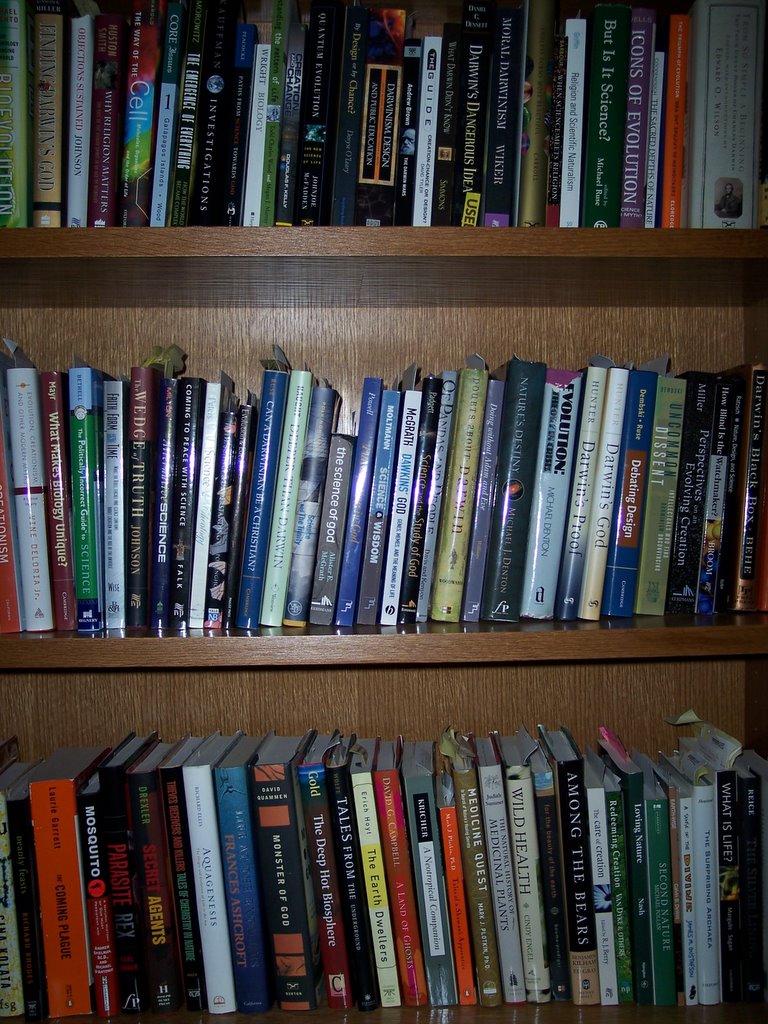
I suppose the whole Intelligent Design thing dogged my brain to such an extent that I was incapable of intelligently designing a blog entry for several weeks. So I let the gray matter relax by allowing it to recreate in the less taxing task of reorganizing my library, now that my new bookcases have arrived.

For some time now my library has taken the form of stacks, not in the public library sense of the word, but in the sense of piles—piles in corners, piles under tables, piles in trunks and cartons. So now was the time to un-stack all my wonderful volumes and give them not only breathing room (some have become very musty) but also some sense of organization and dignity.

So up on the shelves they go. What could be easier and quicker?

Not so fast! Am I going to allow the vertical piles to become mere horizontal piles, a heterogeneous olio of randomness? Doing so would make the library little more useful than when it was “stacked.” So how to arrange the volumes? Surely I can’t be expected to put little stickers on the spines with Dewey Decimal System numbers—or Library of Congress designations! And the Soviet system of grouping books by size, while practical for utilization of shelf space, would hardly be useful for my purposes. So let’s just group the books by general subject matter and see what happens.

***********

It is several days later, and I can report that the literary taxonomy job wasn’t too difficult. The books fell into rather natural categories, including:

*Pure Theology—Bibles, reference, book studies, apologetics, church history, prophecy, devotional.
*Pure Science—biology, ecology, physical sciences, medicine, evolution (is this “pure” science?).
*Science, Creation, ID, and Religion—with books on every side of the issue.
*History and Politics.
*Fiction (a very small section—I prefer “verity”).
*Writing and reference
*Autographed books—several by James R. White; several by my former students.
*Books by favorite authors—Francis Schaeffer, Henry Morris, R. C. Sproul, etc.
*Ramsey High School Yearbooks (43!).
*And, of course, “Miscellaneous” (a surprisingly small category).

Several days later? That job should have taken but a few hours! But who can resist becoming reacquainted with old friends. With some books, it took only seconds or minutes to remind myself of their contents and value, but with a few, a glance and skim didn’t satisfy—I had to dig into whole chapters! Books as diverse in philosophy and content as “Consilience” by E. O. Wilson, “Gaia” by J. E. Lovelock, “Future Grace” by John Piper and “Gleanings From the Scriptures” by A. W. Pink all sucked me in and engaged me for a day or two each. Time flies like an arrow (fruit flies like a banana.)

And so it goes. Maybe some book reports will follow. But for now, it’s back to my librarian’s role. Now, under what category should I put “The ACLU vs. America?”

Monday, December 26, 2005

Bad Statement; Bad Policy; Bad Board; Bad Case; Bad Judge; Bad Decision; Constitutional Confusion; ID Is Not Religious!


The Dover Pennsylvania Intelligent Design court case has finally come to an end. The Judge has ruled for the plaintiff, thus banning even the mention of Intelligent Design in biology classes within the Dover Area School District; and the ruling will probably not be appealed, since the school board that initiated the ID statement to be read to biology students has been voted out of office.

What are we to make of the whole debacle? Trying to sort out all the complexities of the case has my head spinning. Let’s see some of the factors that are making it spin.

Bad Statement. The 160-word statement that was to be read to biology students before the evolution unit looks like it was designed by a committee, as in, “There is an old saying, be it true or be it witty, that a camel is a horse that was designed by a committee.” It was added to, subtracted from and rearranged through many drafts, ignoring suggestions by the science teachers who were to read it. Here it is in its final form:

"The Pennsylvania Academic Standards require students to learn about Darwin's Theory of Evolution and eventually to take a standardized test of which evolution is a part. Because Darwin's Theory is a theory, it continues to be tested as new evidence is discovered. The Theory is not a fact. Gaps in the Theory exist for which there is no evidence. A theory is defined as a well-tested explanation that unifies a broad range of observations. Intelligent Design is an explanation of the origin of life that differs from Darwin's view. The reference book, Of Pandas and People, is available for students who might be interested in gaining an understanding of what Intelligent Design actually involves. With respect to any theory, students are encouraged to keep an open mind. The school leaves the discussion of the Origins of Life to individual students and their families. As a Standards-driven district, class instruction focuses upon preparing students to achieve proficiency on Standards-based assessments."(York Daily Record, January 8, 2005)

In fact, the science teachers refused to read it, so an administrator had to do it.

Bad Policy. Never tell a bunch of proud (egotistical?) science teachers that they have to read a prepared statement, the content of which they don’t believe. My former colleagues would have reacted much like the Dover teachers did. And I probably would have joined them. And the Discovery Institute, the principal Intelligent Design think-tank, refused to get involved in the case because they (along with creationist organizations, such as Answers In Genesis) disagree with mandating the teaching of ID. Permit and encourage, yes; mandate, no, is their policy. It is also bad policy to take action on such a potentially inflammatory issue without wide community support. It takes a lot of educating of the public before taking controversial action.

Bad Board of Education. Their motives might have been good, but their methods and behavior, as I gather from the judge’s decision, were anything but God-glorifying. Apparently they intimidated and threatened non-believing board members and others, even calling them atheists and telling them they were going to hell. They rejected a biology textbook because it didn’t balance coverage of evolution with creationism. There was a mysterious burning of an evolution poster removed from a biology classroom wall. And seemingly, the board members didn’t understand the theory they were trying to support.

Bad Case. A handful of parents instituted the lawsuit, supported, of course, by the ACLU and several other atheistic, church-state separatist and anti-creation groups. The defense was represented by the Thomas More Law Center, whose mission is to “defend the religious freedom of Christians.” – which, of course, could have made a poor impression on the judge, since this was an “establishment of religion” case. Although I have used the term, “Bad Case” to continue in my emphasis of the “badness” of the overall situation, the expert witnesses were scientifically well qualified. Among others, they included Kenneth Miller (Brown University, author of Finding Darwin’s God) for the plaintiffs; and Michael Behe (Lehigh University, author of Darwin’s Black Box) for the defense. They each testified for several days; and reading through the court record of their testimonies was quite informative. In my opinion, Dr. Behe was more convincing—obviously the judge didn’t think so—if, indeed, the decision had anything to do with the expert testimony. In fact, the scientific testimony by both sides seems to have been a mere showcase; and as far as the final decision goes, the judge might just as well have slept through it all.

Bad Judge. I saw trouble coming when I heard that the judge, Honorable John E. Jones III, intended to research the case by renting a copy of the movie Inherit the Wind in order to compare the present case with the “Scopes Monkey Trial” of 1925. At least one organization wrote to the judge to inform him that the movie was a fictional adaptation of a fictional play (which was intended as an anti-McCarthyism message) and that neither movie nor play was in any way an accurate representation of the Scopes trial. Apparently, Judge Jones was not terribly interested in the question, “Is Intelligent Design Theory science?’ but was convinced from the start that it was “religion.” In his 139-page decision, he used language that seemed particularly non-judicial—terms like “breathtaking inanity,” “lied to cover up…” And how about this statement in his decision as a classic example of activist overreaching: “we will enter an order permanently enjoining Defendants from maintaining the ID Policy in any school within the Dover Area School District, from requiring teachers to denigrate or disparage the scientific theory of evolution, and from requiring teachers to refer to a religious, alternative theory known as ID.” Dr. John West of the Discovery Institute opines: "Judge Jones found that the Dover board violated the Establishment Clause because it acted from religious motives. That should have been the end to the case," said West. "Instead, Judge Jones got on his soapbox to offer his own views of science, religion, and evolution. He makes it clear that he wants his place in history as the judge who issued a definitive decision about intelligent design. This is an activist judge who has delusions of grandeur."

Bad Decision. First, it was a bad decision by the Dover Area School District Board of Education to institute the “Intelligent Design as an alternative to evolution” policy without educating the public, without convincing its teachers of the soundness of the policy, and without the imprimatur of the Discovery Institute, the primary ID think tank. Second, it was a bad decision by the Thomas More Law Center to take on the case. It is a fine institution, but they should pick their battles more carefully so as to prevent embarrassing themselves and the cause of Christ. Third, the judge’s decision was bad in that it was based on his confused thinking and his arrogance in believing that in the space of a few weeks he had become an expert in a highly complex field of science and its relation to religion. It is my humble believe that Judge Jones’s mind was made up from the beginning—evolution is science; ID is religion, and that is that.

Constitutional Confusion. Ultimately, the most frustrating thing about this case and so many others is that it should have anything whatsoever to do with the “establishment” clause of the First Amendment of the United States Constitution. That clause, through countless bad decisions through many decades, has become like a wax nose on a dartboard (to badly mix metaphors,) so distorted and punctured so as to have “original intent” advocates despairing of the very survival of the Constitution. Even if ID were in some way “religious,” what happened to the “free exercise” clause?

Intelligent Design is Not Religion. Liberal, atheistic, church-state separationist and scientific organizations, as well as the liberal press and activist judges, have allowed the definitions of both science and religion to be radically changed. The definition of science has been so narrowed that it excludes anything outside of Karl Popper’s “falsifyability” philosophy and ignores the difference between operational science and historical science—and most certainly “denigrates and disparages” any disagreement with the “fact” of Darwinian evolution. And the definition of religion has been broadened to include any suggestion that anything other than the interaction of atoms and energy is operating in the universe.

How did anything get done in science before Karl Popper? How did those Bible-believing creationist founders of modern science ever discover anything without the “modern” definition of science? And what about religion? I always thought it involved words like church (or synagogue or mosque,) worship, prayer and sacraments. The Dover ID case has served to further damage the definitions of both science and religion.

Is Intelligent Design Theory good science? Only time will tell. It is too young, too squelched by the establishment, to have its ideas fairly adjudicated. But the work will go on in spite of bad court cases here and there.

Is ID religion? By any reasonable definition of the term, absolutely not. Does it have philosophical, metaphysical, even theological implications? Of course it does. Every facet of life has philosophical implications, whether we have thought them through or not. But only those with the biblical worldview have the opportunity to appreciate fully those implications. In this matter, there are confused scientists and there are confused Christians. Let us “study to show ourselves approved unto God as workmen who do not need to be ashamed, handling accurately the word of truth”—as it applies to both the material sciences and the “Queen of Sciences”—theology.


Wednesday, December 14, 2005

Some Favorite Darwin Quotes


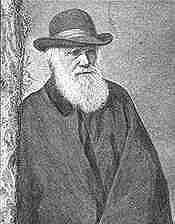
As I attempt to re-familiarize myself with Charles Darwin by skipping and skimming through “Fat Book #1” mentioned in the last entry, I find myself quite impressed with the man, in spite of the fact that we believe that he came to totally false conclusions, for which we may excuse him because he was working with inadequate data and was reacting to the straw man* creationism of his day. But he was a keen observer of nature and a careful documenter of his findings.

Always the gentleman, his writings present a sharp contrast with some of his followers currently in print—no Dawkins-like derogatory characterizations or the simplistic and cynical outbursts of newspaper and science journal editorial writers (See 11/11 and 11/24 posts.)

Here are a couple of my favorite quotes from “Origins.”

“If it could be demonstrated that any complex organ existed, which could not possibly have been formed by numerous successive, slight modifications, my theory would absolutely break down.”

“A fair result can be obtained only by fully stating and balancing the facts and arguments on both sides of each question.”

Of course, the first quote was followed by, But I can find out no such case.” An examination of the fossil record that has been developed since his writing, and a brief talk to Michael Behe or other Intelligent Design theorists would surely offer him some “cases.” Would some irrefutable examples of "Irreducible Complexity" grab his attention?

If Mr. Darwin were alive today and had access to a mere handful of electron micrographs of cell structure, or had the opportunity to discuss probability and information theory with some of today’s specialists in those fields, perhaps, just perhaps, he would reconsider some of his far reaching—and disastrous—conclusions.

As for Professor Dawkins, mentioned above, a short quote will demonstrate the contrast between the objective Darwin and one of his current disciples:

“If you meet somebody who claims not to believe in evolution, that person is ignorant, stupid or insane (or wicked, but I’d rather not consider that.)” –Richard Dawkins, Oxford University

Well, thank you, Professor, for not wishing to consider us wicked. Thank God WE DO recognize our wickedness and our need of our Great Savior!

By the way, I recently included that quote in a letter to the editor of The Record on the subject of Intelligent Design. The editorial staff published the letter—with the Dawkins quote deleted. Hmmm.

*Perhaps "straw man" is not quite the appropriate term for the creationism of the 19th century. Its advocates were sincere in their beliefs, but they had a fixation on fixity of species. Darwin saw too much variability in living things to believe that every species had been created separately. Today's creationists believe in rapid speciation of created kinds, which could correspond to anything from species, to genera or families in the Linnaean system of classification. The field of baraminology deals with this subject.

Saturday, December 10, 2005

Two Fat Books


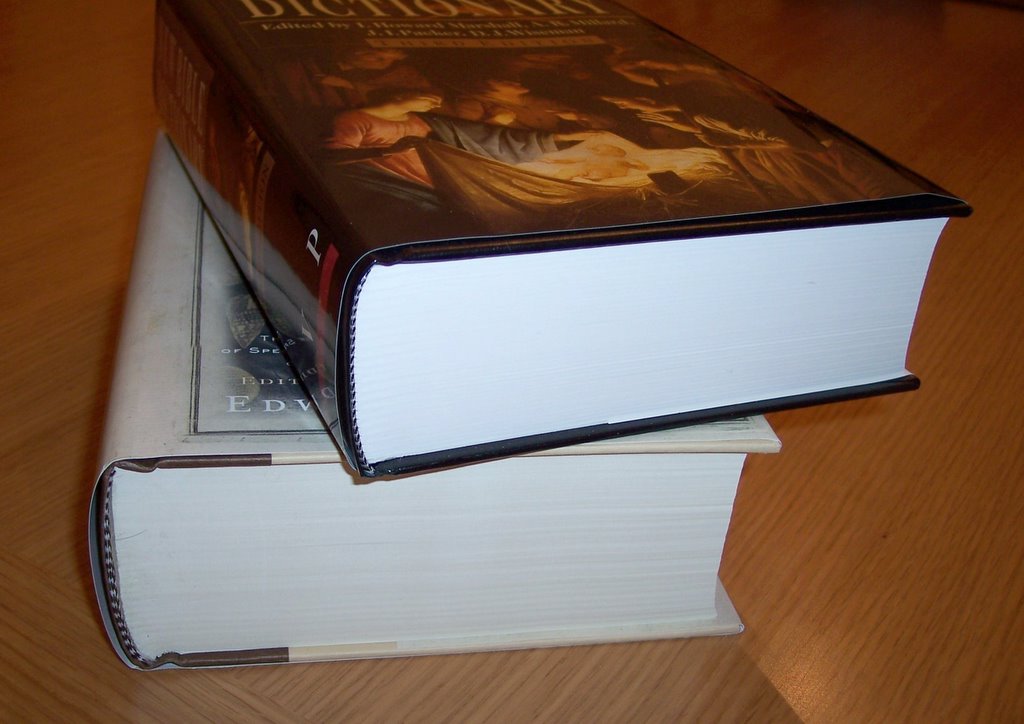
Two fat books have been added to my library in the past few days, thanks to my too-fast trigger finger on the “Order Now with One Click” button at Amazon.com and free shipping on orders over $25. The books are of similar dimensions, each being 9 ½ x 6 ¼ inches. One is somewhat thicker (2 ½ inches) to the other’s 2 inches. But since the thinner book has smaller print, I think the word content of the two volumes might be roughly equivalent.

“Stop with the biblio-trivia and tell us what the books are, already!” OK here is the bibliographical info:

Wilson, Edward O., Editor and with Introductions by: From So Simple a Beginning: The Four Great Books of Charles Darwin. New York: W. W. Norton, 2005.
From So Simple a Beginning: Darwin's Four Great Books


Marshall, I. Howard, A. R. Millard, J. I. Packer and D. J. Wiseman, Editors. New Bible Dictionary, Third Edition. Downers Grove, Ill.: Inter-Varsity Press, 1996 (2004 Printing)
New Bible Dictionary


The reason for boring you with trivial information about book dimensions is to emphasize the point that it is not the paper, cardboard, thread, glue and ink that make a book what it is. Nor is it those funny little symbols, in and of themselves, strung together in short groups to make words, which are strung together to make phrases, clauses and sentences, paragraphs and chapters. What makes a book, in any useful sense of the word, is the information embedded within those strings of symbols.

That information remains hidden until and unless a human being decodes and interprets it. It takes children six, seven, eight years to learn how to decode that information and several more years to learn how to express themselves effectively using that code. The whole process is exquisitely complex. Things can go wrong. Ask any dyslexic, or an unfortunate child who was exposed to the disastrous “whole language” fad in reading education.

Translating that printed code into speech is even more complex. I once took a course called “The Anatomy and Physiology of the Auditory and Speech Mechanisms.” The course covered every muscle from the waste up, (including by favorite, the tensor veli palatini) the anatomy of the respiratory system and the nerves supplying it, the ear and its innervation and most of the brain. (I’m sorry, but anyone who fools himself into thinking that all of that stuff just “evolved” is just plain deluded or nuts! Pardon me for sounding a little like Richard Dawkins, who uses similar adjectives when referring to creationists—and pardon this editorial interruption.)

In terms of complexity, the transmission of information from one human mind to another human mind is of another order of magnitude higher than all of the above. If the communication is through face-to-face speech, people have to talk precisely and repetitively to have any assurance that a thought in one person's head has been received and understood by the other. If communication is through the written word, the writer must write even more precisely, because there is usually no opportunity for feedback. (In fact, this dumb paragraph has been rewritten several times and I’m probably still not communicating.)

“But Bioman, you surely are going to tell us why you selected the two books you are using as examples. You didn’t pick them, did you, simply because they are fat recent arrivals.” Ah, yes. Bioman has an ulterior motive (or actually a higher motive.) I picked them because of their similar size, weight, word count and amount of information to emphasize not their similarity but the enormous contrast between the two volumes. The contrast lies in those non-material entities called ideas. Ideas are more than information. Information is a non-material entity riding on a material substrate, such as the printed word (or in some electronic medium.) Ideas are non-material entities riding on a non-material substrate—information. They are abstractions of abstractions. And that is what makes them so wonderful, yet so potentially dangerous.

Beside their physical similarities, the kinship of our two fat books lies in the fact that they are both attempting to communicate big—in fact, world-shaking—ideas. The contrast—Bioman is finally getting to it—lies in the antithesis of the big ideas in the two books and the night-and-day difference in the effects the two have wrought in the world. Just a glance at the two titles should make that self-evident. The analysis of those ideas, however, will have to wait for a future bloggeration. I have overextended my visit for this session. Was that a cliff-hanger—or a cliff dropper?

Tuesday, December 06, 2005

Cold Hike; Cute Coots


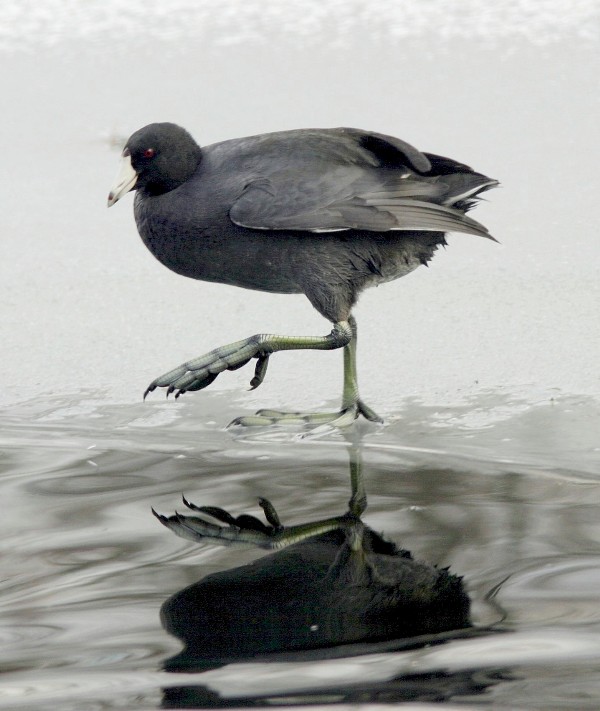
Today I celebrated the veering off to the east of a major snowstorm by enjoying a short hike at the Celery Farm Natural Area. If I were a serious birder, interested in making a long list of species observed, this would have been a disappointing walk. I scared up a few chickadees, a catbird and some unidentified sparrows in my walk half-way around the lake. There was also a small flock of gulls and a hunched up, unhappy looking great blue heron on the iced-up lake. Mostly, I spent time enjoying a flock of a dozen or so American Coots, which were concentrated in a small area of open water. It gave me the opportunity to see these rather unusual duck-like, yet not duck-like birds closer than usual. We usually see them floating; today I got to see a couple standing on the ice, revealing their outsized green feet with their unusual lobed toes, which you may be able to see in the photo.

This adaptation seems like a good compromise between fully webbed feet, which may somewhat inhibit walking on land, (one reason why ducks waddle and say “ouch, ouch”—the translation of “quack quack”) and the non-webbed feet of the coot’s cousins, the gallinules and moorhens. Having long toes enables those birds to walk where others fear to tread, such as on lily pads, but probably makes them non-competitive swimmers. Long, lobed toes offer a wide platform for standing and walking and enough toe surface area for paddling. So all-in-all, the coots are well-designed tubby little floaters. And I thank their Designer for giving me the chance to see and photograph a group of them up-close and personal today. Soli Deo Gloria

p.s. I hope you enjoyed this non-controversial post. Writing it gave me relief from thinking of all the dead bears out there, as this was the second day of New Jersey's controversial bear hunt.

Friday, December 02, 2005

No blood tossing; no shrink-wrapping

No blood tossing, no shrink-wrapping, no “Your Mommy’s a Murderer” handouts—it’s the Christian Vegetarian Association. While “CVA” doesn’t have quite the ring as “PETA”, the dietary recommendations of CVA are ringing true with at least some believers.

No sooner had I bloggerated about PETA (see 11/28 post) than a column by David Briggs shows up in today’s paper: “Christian vegetarians turn to a Garden of Eden Diet.” The article describes the motives, biblical rationale, activities and dietary recommendations of CVA, a Cleveland-based group formed as a Christian alternative to the very secular and religion-averse PETA.

The CVA website, http://www.christianveg.com/default.htm offers much the same fare as PETA’s, the most sensational (perhaps sensationalist?) of which is the section on the medical, environmental and economic downsides of “flesh eating,” as well as the health benefits of the vegetarian diet. They seem quite convincing to me and are worth a look.

The descriptions of meat, milk and poultry production are not pretty and they are accompanied by photos intended to upset. So I won’t include any here, especially the turkey photos, which would not be appreciated so soon after Thanksgiving. (even if the Blogger program would allow me, which I don’t think it does—or at least I haven’t figured it out yet.)

We should be thankful, at least, that there are organizations that point out animal abuse (and in the case of PETA at least,) put up a legal fight against it.

The thing that I like about CVA, as compared to PETA, is its biblical approach. At least they try to approach the subject from a biblical worldview and honor and give glory to the only One who deserves any. Whether or not strict vegetarianism can be legitimately supported by scripture is debatable (which debate is presented in Briggs's column) at least CVA is trying. And that’s a good thing (was that a little Martha-esque?) And the positive, encouraging approach may, in the end, be more effective. At least it’s not nasty.

These are important issues to think about and act upon, if the Spirit moves. And now we will move on to other topics—unless something else shows up on the subject in one news medium or another. Happy eating, whether from the flora, fauna, or both.

Bioman, in case you're wondering, will not become a vegan any time soon. I don't eat a tremendous amount of red flesh--maybe a once-a-year cholesterol special, like a double cheese bacon burger at Friendly's. But if you are convicted by these blogs, why not give the veggie lifestyle a try?

Monday, November 28, 2005

Shrink-wrapped PETA


If all the shrink-wrapped PETA members in the world were laid end-to-end, it would be good to just leave them that way.

I realize that this subject is strikingly fresh (can you see the expiration dates on the PETA packages?) But I thought I should escape from Intelligent Design for a spell and comment on un-intelligent activities, like being shrink-wrapped and put on public display.

When I first saw this picture, my reaction was the usual, “What are these crazy people up to now?” Then I thought, “At least this is fairly harmless (except for the danger of suffocation) and less disgusting than splashing blood on fur-clad ladies or handing out leaflets to small children, telling them that their parents are murderers for roasting turkeys or going fishing.”

Then I decided to see if engaging in these embarrassing activities is all that PETA (People for the Ethical Treatment of Animals) does as an organization. So I Googled and found their website http://www.peta.org/ —or I should say sites, for they have literally dozens. I was quite surprised to find out how big the organization is and how much they do, not only by way of silly and offensive demonstrations but also in more legitimate educational and legal persuits.

The PETA sites also gave me new insight into the extraordinary amount of animal cruelty that goes on in the world and in numerous industries, many of which we don’t or would rather not think of as animal abusers: food, entertainment, cosmetics, medical research, education and many more. I know that you would benefit from—and be shocked by--perusing PETA’s material.

Of course, PETA’s very evolutionary “we’re all relatives” philosophy makes them go way too far. Their descriptions of animal groups are precious. Fish, for example are portrayed as, “ smart, sensitive animals with their own unique personalities. They have excellent memories and can learn to avoid nets by watching other fish in their group and can recognize individual “shoal mates.” Some fish gather information by eavesdropping on others, and some even use tools. Says marine biologist Dr. Sylvia Earle, “They’re so good-natured, so curious. You know, fish are sensitive, they have personalities, they hurt when they're wounded.” Enjoy more at: http://www.goveg.com/amazingAnimals.asp

PETA encourages people to be vegetarians, especially vegans, as even the dairy industry is rife with cruel practices, and “milk is for babies.” And that may be a good thing. The vegans I know look fairly bright-eyed and bushy-tailed and make me look sicker than I actually am.

From a biblical viewpoint (the only one that really counts) flesh eating was permitted after Noah’s day because God’s curse on the ground had made it ever more difficult to get sufficient nourishment from the degraded plant kingdom. (See Gen 1:29-31 and 9:1-4 for the before and after commands.) But also see Paul’s warning against dietary and other prohibitions in I Tim 4:1-5--legalism kills grace!
The world offers an almost infinite variety of dietary advice, as a visit to the diet and cooking section of a book store will reveal—no meat, no dairy, no grain, high this, low that, no this, all that. Try these for varied titles:
The No-Grain Diet by Joseph Mercola (Was he also the author of that old song, "Get out of the wheat field, Nelly, you're running against the grain"?)
The Maker's Diet by Jordan Rubin (I don't think the Intelligent Designer designed this one. And it mostly likely excludes my favorite sandwich, the Rubin Grill.)
Kill It & Grill It: A Guide to Preparing and Cooking Wild Game and Fish by Ted Nugent (I think Ted and Shemane look even more bright-eyed and bushy-tailed than the vegans I've met.)
I guess there is no end to the making of diet books. Pick whatever suits your taste and doesn't kill you right away.

Well, we have wandered far and wide in this bloggeration. Now I should go and see if there are any PETA-approved tidbits in my cupboard for lunch—or maybe I'll find some sensitive, good-natured sardines.)

p.s. OK, I suppose I shouldn't make fun of all those special and varied diet plans that folks dream up. Some of them have probably been of great benefit to those who have the discipline to stick with them. It is true that our love for carbs has caused a pandemic of obesity and diabetes in this country, and maybe that no-grain diet may be a solution. So if you think you can do it, by God's grace, go to it.
The Maker's Diet is supposed to be biblically based (post-flood, because it includes meat) and it saved the author's life. It does get expensive, so I'm told, with all the supplements required, but it probably works for its stick-to-it-ers.
As for Ted and Shemane's program, they say that they haven't eaten store-bought meat in thirty years. If you live where you can hunt and have a yo-big freezer, and you can look those wonderful game animals in the eyes and shoot'em anyway--more power to you.

Saturday, November 26, 2005

Am I defending Intelligent Design Theory?


In several recent posts I sound like I’m defending Intelligent Design Theory. In fact, I am and I am not. The situation is not as simple as an up or down vote in Congress (I suppose that’s a poor analogy.) It is both simpler and more complex than that.

My aim is to confuse, and I most likely have done that in a mere four sentences. But let’s try to figure this thing out. Such figuring is not easy in these days of hot debate and the throwing around of terms and the throwing up of dust. (But let me be clear: we won’t figure it out in one blog post—or if I should blog about the subject until the proverbial bovines return to their domicile.)

First, let’s make some distinctions. Intelligent Design Theory is not the same as Biblical Creationism. The ID theorists are trying (if the evolutionists, the press and the general public would let them) to approach their ideas as pure science. They are smart people and they know how to separate their science from their theology. (Whether that is a good thing or not I will discuss later.) Their main premises are that (1) living systems are too complex to have been produced by blind chance and natural selection, and (2) evidence of intelligence can be detected in the design of living systems. In their personal beliefs, supporters of ID are all over the map. Some are theistic evolutionists; some may be Biblical Creationists others, agnostics. Their religions range from Protestant to Roman Catholic to Unification Church to Judaism—and probably many others.

Biblical Creationists, on the other hand, openly admit to using God’s Word as the basis of their worldview and as their approach to science. In their operational (experimental) science—science in which repeatable experimentation and falsification are the rule—they operate under the belief that God created and sustains His universe by laws that can be discovered by science (thinking God’s thoughts after Him.) In studying prehistory, however, Biblical Creationists realize that different rules apply. The past is not subject to repeatable experimentation. Evidence (the same evidence that any scientist has available) must be interpreted according to un-provable (in the scientific sense) assumptions and philosophical (religious, if you prefer) presuppositions. This is where God’s Word must take precedence over purely naturalistic assumptions and must act as the guidebook for the interpretation of evidence.

People claiming to be Biblical Creationists also come in a variety of flavors, ranging from YECs (Young Earth Creationists,) OECs (Old Earth Creationists,) Theistic Evolutionists, Progressive Creationists, etc. Of course, I believe that only one of these flavors has any real taste--is consistent with the grammatical/historical interpretation of the Bible.

Bioman from Jersey proudly (or humbly) wears a YEC t-shirt and is blessed to be persecuted for his position (So there, now you know—and probably suspected) I believe that any other position severely compromises God’s Word and the gospel—in fact, God’s whole plan of salvation. And that is the last thing any Christian should be doing. I realize that sincere people hold to other positions, but I believe that sincerity, by itself, plus $2 will get you a ride on the NYC subway (unless the fare has gone up again.)

That brings us to my original question: am I defending Intelligent Design Theory? The answer now is the same as I started with—yes and no. I believe that, as far as it goes, ID is a legitimate scientific approach to the study of origins. While it is not strictly inductive and open to falsification, neither is any other study of the past, in spite of the claims of materialist scientists.

My gripe with ID is that it doesn’t go far enough. It refuses to openly identify and honor the Intelligent Designer and is therefore legitimately criticized by its opponents, including Charles Krauthammer, whom I blasted in a previous blog post. If the ID-ers are not willing to openly admit their theological position(s) they will continue to be lambasted by unbelieving critics as committers of subterfuge and fraud. Better to admit their theistic assumptions and be persecuted as fools (I Corinthians 1:27) That is not an easy thing for a scientist to do—it will cost him dearly. But that is what Christianity is all about, is it not?

The issues here are broader and deeper than I have stated and range from the definition of science to the really big issue: Who created, cursed, sustains—and soon will redeem the created universe? Let’s face it—there are believers and there are unbelievers, and He knows who they are. Soli Deo Gloria.

Thursday, November 24, 2005

Stick to politics, Charles!


Charles Krauthammer, columnist for the Washington Post and contributor to the Fox News Network, is one of the more intelligent, politically savvy journalists in Washington. His conservative positions are strongly and eloquently stated, both in print and on air. But recently, in his newspaper column, he ventured away from Washington politics and into science and religion, revealing his ignorance and confusion concerning both.

The subject was—what else these days—the Intelligent Design court case just concluded in Pennsylvania. But he was aiming at a broader target: any thought that there is a conflict between “science”—especially evolution—and “religion.” He starts by saying that neither Newton nor Einstein saw any conflict with science and their particular views of deity, then proceeds to describe the God of the Bible as a “crude and willful God who pushes and pulls and does things according to whim.”

We’re beginning to see that Mr. Krauthammer’s theology is somewhat suspect. Now what about his science and his opinion of Intelligent Design theory? In the column’s headline he calls ID a fraud; in the column he calls it “today’s tarted-up—or warmed-over—version of creationism” and an “insult both to religion and to science.”

The 800-word slam continues with too many errors and misrepresentations concerning science, ID, creationism, the Dover PA and Kansas School Board situations and God to remark on here. But the final paragraph is a corker. This man is obviously passionately in love with goo-to-you evolution. Here it is, in full:

How ridiculous to make evolution the enemy of God. What could be more elegant, more simple, more brilliant, more economical, more creative, indeed more divine than a planet with millions of life forms, distinct and yet interactive, all ultimately derived from accumulated variations in a single double-stranded molecule, pliable and fecund enough to give us mollusks and mice, Newton and Einstein?

Well, isn’t that precious (as the Church Lady used to say.) Here’s MY version:

How ridiculous to make evolution a friend of God. What could be more ugly, more chaotic, more unintelligent, more wasteful, more degrading, indeed more demonic than a planet with millions of life forms, distinct and yet interactive, suffering for millions or billions of years with pain, disease, predation, parasitism, bloody competition and death, all ultimately derived from accumulated chance, purposeless variations in a double-stranded molecule, pliable and fecund enough to turn pond scum into mollusks and mice, Newton and Einstein—and Krauthammer.

Perhaps Mr. Krauthammer hasn’t thought through the implications of his worldview, both the scientific and religious aspects—or perhaps there is a chip on his shoulder (as I surmise from the tone of the column,) a shoulder not far from an otherwise brilliant mind.

Let us pray for this man, that he may recognize his desperate need for the Savior.

“If you don’t understand Genesis 3, you don’t really understand anything.”