Why we are here:

Our signature Bible passage, the prologue to John's Gospel, tells us that Jesus (the Logos) is God and Creator and that He came in the flesh (sarx) to redeem His fallen, sin-cursed creation—and especially those He chose to believe in Him.

Here in Bios & Logos we have some fun examining small corners of the creation to show how great a Creator Jesus is—and our need for Him as Redeemer. Soli Deo Gloria.

***

Wednesday, July 07, 2010

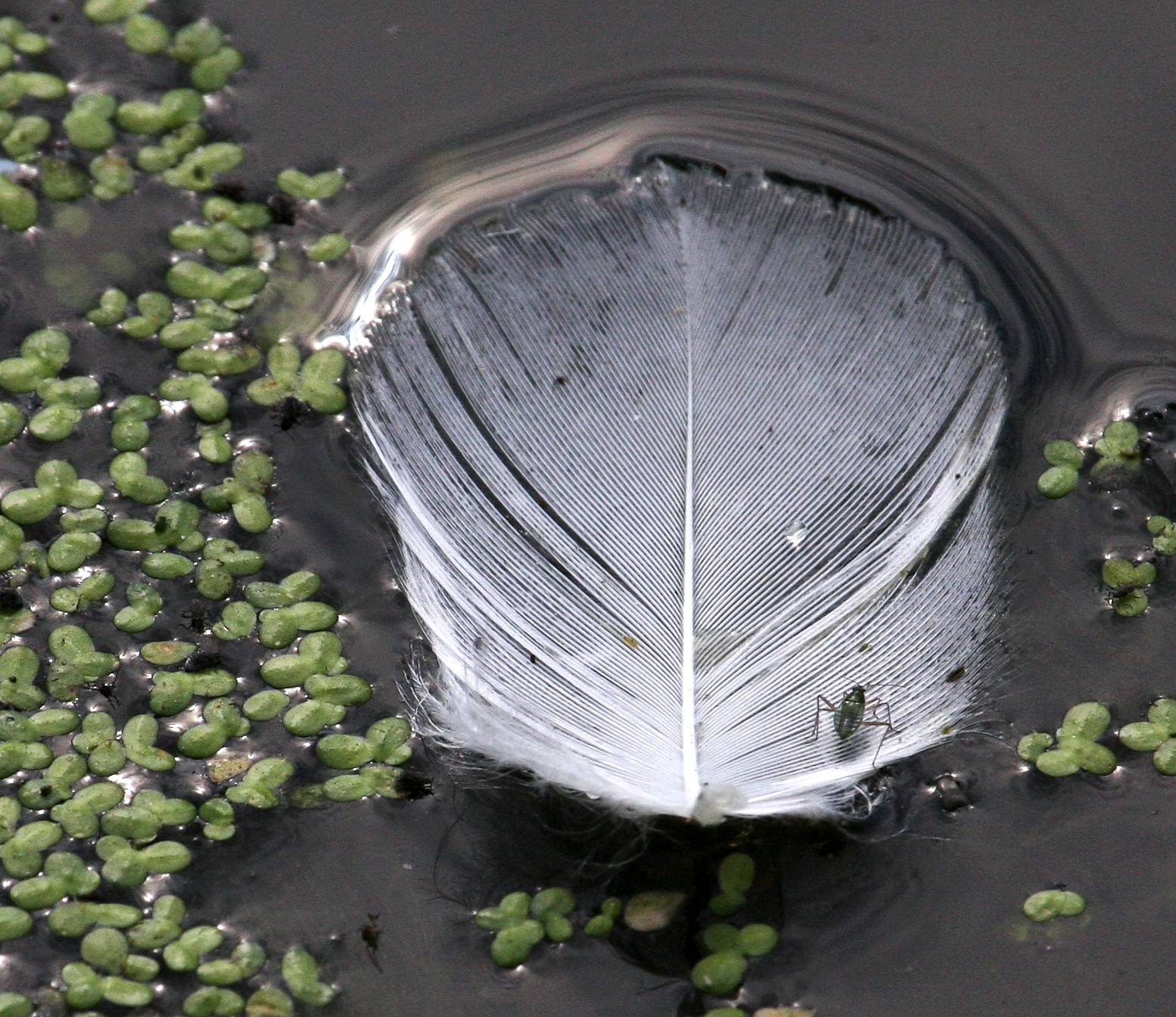
Three Tummyaches

Duckweed, goose feather or the bug on the feather--which should cause the darwinist the biggest case of indigestion? Answer: all three should be equally as nausiating to the devotee of random mutation and mindless natural selection as mechanisms by which these organisms have originated.

Botanists may call the duckweed a simplified version of a flowering plant, with only one leaf and some dangling roots. But any flowering plant, with its photosynthetic mechanisms, deserves the Darwin Abominable Mystery Award.

Feathers are not frayed reptile scales! While scales are mere epidermal folds, feathers originate from incredibly complex follicles--even more intricate than human hair follicles.

And as for the bug--Nobel Prize Astronomer Fred Hoyle once said than insects are so incredibly complex and weird that they couldn't have originated on Planet Earth--they must have arrived as spores from space.

Don't be duped by the popular literature, or even by "serious" scientific literature, that insists on clinging to increasingly stale, out-dated theories. In fact, doing a little digging into some time-proven literature, such as Genesis 1 and 2, might be profitable for learning about the true origins of life--and everything. But don't forget to go on to Genesis 3, because if you don't understand what happened there, you don't really understand anything about today's beautiful but sin-cursed world.

Soli Deo Gloria

Tuesday, July 06, 2010

The Right Flower/Bee Match


Yesterday, we saw a carpenter bee straddling a milkweed blossom and draining nectar from deep within the flower. No problem for the bee or flower, except for the fact that the energy-rich nectar was produced by the plant precisely for the purpose of attracting pollinators. The bee, however, is taking the nectar without necessarily picking up any of the golden pollen bodies (pollinia) because its feet are avoiding the slots in which they are lying in wait.

Today we see the insect for which the milkweed blossom is intricately designed--the honeybee. The bee perched on the leaf edge has visited several flowers and is literally weighed down with glistening pollinia. She will eventually continue her nectar gathering and will most likely deposit at least some of the pollen on the stigmas of the visited flowers, thus assuring the fertilization of the ovules deep within. In a few weeks, a pod containing hundreds of seeds will develop--and the reproductive cycle will have been completed.

Evolutionists would call the adaptations of bee and flower "co-evolution". But even devout darwinists are beginning to doubt that random mutations and natural selection are capable of producing such intricate mechanisms, let alone producing flowering plants and insects in the first place.

There are untold thousands of plant/insect relationships throughout the biosphere, many even trickier than those shown here. Information theory and probability theory argue powerfully against their existence without the designing power of mind--the mind of the Creator of all things, the God of the Bible, whose Son not only created all things but sustains all of His creation and redeems His elect people from their sin. He is Lord of All. (John 1:1-3; Colossians 1:16-17)


Soli Deo Gloria

Monday, July 05, 2010

Getting Down to Bees-ness


Since I have been particularly sporadic in my posts this year, I thought that something a little more spontaneous might correct the situation. Let's try some periodic photos with short blurbs, rather than the longer essays you are used to seeing.


No matter what the subjects of the photos may be--and they will certainly be small examples of God's creative handiwork, as our theme has always been--we should keep two passages of scripture in mind as we stare at the color, form and detail of each photographic subject: Colossians 1:16-17; and Romans 1:18-20. In essence, they say, (1) Jesus made them and holds them together; and (2) We had better recognize Who made them or we are in big trouble. "Under the wrath of God" is a terrible place to be.


So let's get down to business--or bees-ness--with the above photo of a carpenter bee extracting nectar from a milkweed blossom. Both bee and blossom exhibit intelligent design beyond our wildest imagination. Any thought that either could have "evolved" by random mutations and natural selection is an insult to the God Who created them.


Of course, there is a touch of Romans 8:19-22 seen in the photo as well. The carpenter bee is cheating on the flower by stealing nectar without necessarily carrying out the pollination duties for which the flower was designed. Tune in tomorrow to see a better flower-to-pollinator match.


Have you bothered to look up those passages? If not, why not pause to do it now, so you can make some sense of this little blurb. You can look them up in the Searchable Bible link on the right side.


Soli Deo Gloria

Thursday, May 13, 2010

Have you considered spores lately?

Have you been contemplating the subject of spores these days? Not likely, unless you’re a total botany nut like me. But most likely you have been experiencing—even suffering—the effects of spores during this spring season. Let me explain (be patient—this may take a while).

The photos above, mostly shot within the past month, all have to do with spores of one sort or another…

But sir, you haven’t even given us a definition of the word! What kind of teacher are you?!

OK, a spore is a unicellular (usually microscopic), monoploid reproductive structure which will germinate and grow into a plant if given suitable conditions.

That was not helpful, sir. You’ve only further confused us.

Very well, allow me to at least define some of those terms:

Microscopic: teensy weensy
Unicellular: comprised of one cell
Monoploid (AKA haploid): containing one set of chromosomes
Reproductive: makes a baby something
Germinate: sprout
Grow: get bigger
Plant: a multicellular usually photosynthetic organism
Suitable: nice

Sir, we sense a bit of sarcasm and condescension in some of your definitions.

So be it. Let’s go on. Perhaps describing some of the photos will help. The top two photos show some moss sporophytes.

What’s a sporophyte?

A plant that reproduces by means of spores. And I wish you wouldn’t interrupt so often. You’re beginning to sound like Neil Cavuto!

OK, sir. But we’re only seeking clarification—just trying to get edjacated!

That’s ed-u-cated! Those sporophytes, consisting of a stalk and a spore capsule, produce microscopic spores by the process of meiosis

Sir…

Look it up for yourself!!

The spores get sprinkled out, using a magnificently designed mechanism involving changes in humidity and those little teeth you see in one of the photos…

But sir…

Yes, Neil?

Magnificently designed? But sir, I thought all good biologists believed in mindless chance mutations and natural selection to produce complexity.

NOT! They’re designed! Anyway, some of the sprinkled spores land on nice moist soil and germinate into gametophytes…and before you rudely interrupt, a gametophyte is a monoploid plant that reproduces sexually by the union of gametes—and don’t tell me you’re not old enough to know what that means! The green moss plants that we usually associate with mosses are the gametophytes. I won’t go into the sexual process here, but it involves antheridia, archegonia, mitosis and the morning dew.

Sir, you are deliberately avoiding an obviously controversial but important subject!

Perhaps I’m merely teasing the next lecture. Today, we are dealing with spores. To continue, the fertilized eggs grow into the sporophytes you see in the photos. It’s all about what we call “alternation of generations.”

The third photo shows the fertile (spore-bearing) frond of a fern. Same story: the spores will be sprinkled out, land on moist soil and grow into gametophytes, which are really small, so we seldom see them—but that’s another story.

But sir…

I’ll ignore that interruption.

But sir, we want to know about the fourth photo—those flowers—what do they have to do with spores? We thought flowering plants reproduced by means of seeds, not spores.

Excellent thought (for a change). The flowers actually are groups of sporangia (spore-bearing organs). We just call them by different names, just to confuse. In fact, flowers produce two kinds of spores: microspores (small ones) and megaspores (big ones). It’s called heterospory. We call the microspores pollen grains (which contain sperms) and we call the megaspores ovules (which contain eggs). And we call the processes of how they get together pollination and fertilization—another tease for the next lecture.

Pardon another rude interruption, sir, but at the start of your bloviation you said that we were experiencing and even suffering the effects of spores during this spring season…oh, we see it now—that yellow stuff all over our cars is pollen—microspores! And the fact that half of us are blowing our noses and popping allergy pills—now we get it!

I am amazed! But don’t blame the pretty chokecherry blossoms in the photo for your problems—because they’re entomophilous! It’s the anemophilous pollen that yellows your cars and causes hay fever.

Now really, sir…

LOOK THEM UP!!!!!!

Sunday, January 24, 2010

Dead Leaves


It’s nearing the end of January, so I suppose you are wondering why you’re seeing a bunch of dead leaves in this usually seasonally topical blog. The simple reason is that I use this photo as my Windows wallpaper on my computer and it keeps reminding me of its presence and (to me at least) attractiveness, every day.

You can learn a lot by looking at dead leaves. For instance, you can tell what kind of forest community (what kind of trees are growing together) the leaves are a part of. In this case, it’s primarily a community of oaks, beeches and birches. From that information, you should be able to tell something about the forest’s climate and geology, as well as the chemistry of its soil. A veteran Bergen County hiker might be able even to identify the woods where the photo was snapped.

Beyond the ecology, it’s the structure of the leaves themselves that draws me in. Dead as they are, they maintain their intricately engineered structure after the abscission process has nudged them from their parent trees. Fortified with cellulose and lignin, the outer form, especially of the oaks, may endure for months or even years before offering up its structure to dehydration, oxidation and fungal decay, the biosphere’s slow but efficient recycling machine.

A few months earlier, our fallen leaves had been vibrant solar-powered food factories, sucking up Carbon Dioxide and puffing out Oxygen in the process of producing carbo-hydrates, proteins, fats and an amazing cornucopia of other complex organic compounds ranging from pigments to toxic alkaloids. The cell layers of each leaf are engineered for controlled light absorption and gas exchange, while the organelles within each cell are working their magic in biochemical pathways that boggle the minds of biology students and should, when considered without naturalistic bias, cause nightmares for evolutionists. One glance at even a simplified depiction of the Calvin Cycle (oh, that’s what that funny diagram is) should tip any objective mind toward Intelligent Design and away from mindless evolution. (By the way, that biochemical pathway is named after Melvin, not John, as much of a fan of the latter I may be.)

Another glance at our forest floor detritus has me contemplating subjects more profound, such as the condition of the organized church and our individual Christian lives, about externals versus internals and such. I know that’s a stretch, but that’s how the SAITUAHFTC Principle* works (or should work) in this blog.

There is no doubt that the old denominational churches, as well as so-called non-denominational churches, are in big trouble. They have strayed from biblical orthodoxy in countless ways, ordaining women and homosexuals, centering on entertainment, showmanship and seeker-friendly worship—and often straying from the very foundations of the Gospel. Even the conservative churches, while maintaining strict adherence to reformation doctrine, seem sometimes to be spiritually dead, their outward structure hiding inward dryness and decay. The charismatic groups, while claiming to be “filled with the Spirit,” often exhibit bizarre emotionalism, mostly devoid of doctrinal content, stretching the limits of biblical “decent and orderly” behavior in their worship.

So what’s new? The problem with the churches is that they are filled with a bunch of weird, miscreant oddballs called—sinners, saved by grace. And such has it been from the start. The first century churches were a handful for their leaders, always straying into either legalism or permissiveness of gross immorality, protognosticism and other false philosophies. Most of the New Testament epistles were written, at least in part, as correctives of such misbehavior and errant thought. And only two of the letters sent by Apostle John to local congregations included no condemnation from Jesus. The church at Sardis, in particular, was a really “dead leaf” bunch. And the Lord threatened to push the Laodicean leaf off the tree (spew them out of His mouth).

Then there is the rest of church history—one heresy after another having to be fought over and corrected; the construction of a monstrous, legalistic hierarchical organizational structure, gross immorality in leadership, even selling tickets out of Purgatory—so bad that God had to bring the Reformation to bring His Church back to its roots.

One of the tenets of the Reformation is “semper reformanda”—always reforming. That doesn’t mean always changing, as seems to be the habit of the modern church, but rather, constantly re-examining, detecting and correcting our constant tendency to drift from the truth.

But thank God that the dead leaf analogy that started this harangue is only partially and temporarily consistent with truth! Yes, dead leaf churches and congregations have always had to be pushed off the tree—for the survival of the tree. Dead leaves are not only useless, they can—through the accumulation of snow in winter—cause damage to the branches and the entire tree. It is the massive tree—roots, trunk and branches—His Church—that He promised would survive through thick and thin, until He returns.

In another sense, we, as individual believers, are His leaves. Are we clinging to our Branch? No! The Branch is clinging to us—with His almighty strength! He will never let us go! But we too must constantly be practicing semper reformanda, detecting signs of dryness, returning to His Word for nourishment and strength, as we endure the vagaries of life in the forest of His fallen creation. The mere thought of becoming mere skeletons of cellulose and lignin should literally put the fear of God in us.

Yes, dead leaves can get us thinking!

*SAITUAHFTC: Start anywhere in the universe and head for the Cross.
Soli Deo Gloria

Thursday, January 07, 2010

A Webby Declaration

The pictured Barn Spider has long ago headed back to the barn for the winter, but I’ve dragged him out photographically because he is such a great example of practically everything. Sooner or later, we’ll probably use him to illustrate several aspects of the intelligent design of his anatomy, physiology and biochemistry. But this time, we will wander far from the biological barn and into the theological woodshed.

As Sir Walter (Scott, that is) said, “Oh what a tangled web we weave when first we practice to deceive.” Our spider’s web seems a bit tangled, primarily because this nosy photographer got too intimate with a macro lens. But right now, I’ll get nosy with a subject of theological controversy brought about by the publication of a document called
The Manhattan Declaration. (Click on the link and then on the “The Declaration” tab to read the entire document.)

The document is signed by a long list of conservative religious leaders and more than three hundred thousand others who are rightly troubled with the state of American society. It says, essentially, to paraphrase
Howard Beale, “We’re as mad as heaven and we’re not going to take this anymore!” And we’re willing to go to jail as a last resort, if civil disobedience is the only possible response.

The three principles being defended in the Declaration are (1) the sanctity of human life, (2) the dignity of marriage as the conjugal union of husband and wife, and (3) the rights of conscience and religious liberty.

So where is the web? Where are the tangles? Anyone with even a semblance of a biblical worldview or even a basic human sense of moral values should agree with the Declaration’s premise that we shouldn’t kill babies or old people or people with disabilities; that the “traditional” view of marriage is the only sane one; and that the U. S. Constitution should ensure our right to free speech and public expression of religious views.

The problem, in the view of several conservative Christian theologians, lies with the following statement:
“It is our duty to proclaim the Gospel of our Lord and Savior Jesus Christ in its fullness, both in season and out of season. May God help us not to fail in that duty.”

Proclaim the Gospel? Which gospel? The three groups represented proclaim three different and antithetical gospels!

One of the representative sects of Christendom proclaims a gospel that is, when closely examined, a monstrosity of legalism, ritualism, idolatry and ultimately, blasphemy. It presents a savior who doesn’t really save. Another group practices a religion based almost entirely on its ritualistic liturgy but is mostly unintelligible to outsiders.

Only evangelical Christianity, and then only in its pure Reformation variety, proclaims the true biblical plan of salvation: salvation by grace alone, through faith alone, on account of Christ alone, as revealed in Scripture alone—thus giving all glory to God alone. In short, it has a Savior who really saves His people from their sins (Matt 1:21).

So the authors of the Declaration dare not proclaim “the Gospel” within their document. They are stuck in the tangles of a theological spider web. While their intensions are good from a moralistic viewpoint, their unwarranted ecumenism thwarts their ability to fight the real battle being waged in this fallen world—the spiritual battle for the hearts and souls of fallen humanity. Or at least, their ecumenical entanglement has them somewhat unequally yoked (2 Cor 6:14).

Moral and societal woes are ultimately spiritual problems. We can take potshots at them and gain some superficial, temporary victories, but only God’s sovereign grace, capturing and transforming sinful human hearts, will win the war.

I’ll leave the links to The Manhattan Declaration here for the time being because it has much to offer. But ultimately it, like our pictured arachnid, might have to go back to the barn. I am still praying about its ultimate disposition.

As one of my favorite theologians says, “The Gospel is ours to proclaim, not to edit.”

Soli Deo Gloria

Sunday, December 20, 2009

Merry Christmas to All!

Christmas Holly’s thorny leaves and blood-red fruit—a hint of the true reason for the incarnation

She will bear a Son, and you shall call His name Jesus, for He will save His people from their sins. Matthew 1:21 (English Standard Version)

The Birth of Jesus Christ
1In those days a decree went out from Caesar Augustus that all the world should be registered. 2This was the first registration when Quirinius was governor of Syria. 3And all went to be registered, each to his own town. 4And Joseph also went up from Galilee, from the town of Nazareth, to Judea, to the city of David, which is called Bethlehem, because he was of the house and lineage of David, 5to be registered with Mary, his betrothed, who was with child. 6And while they were there, the time came for her to give birth. 7And she gave birth to her firstborn son and wrapped him in swaddling cloths and laid him in a manger, because there was no place for them in the inn.

The Shepherds and the Angels
8And in the same region there were shepherds out in the field, keeping watch over their flock by night. 9And an angel of the Lord appeared to them, and the glory of the Lord shone around them, and they were filled with fear. 10And the angel said to them, "Fear not, for behold, I bring you good news of great joy that will be for all the people. 11For unto you is born this day in the city of David a Savior, who is Christ the Lord. 12And this will be a sign for you: you will find a baby wrapped in swaddling cloths and lying in a manger." 13And suddenly there was with the angel a multitude of the heavenly host praising God and saying, 14 "Glory to God in the highest, and on earth peace among those with whom he is pleased!"
15When the angels went away from them into heaven, the shepherds said to one another, "Let us go over to Bethlehem and see this thing that has happened, which the Lord has made known to us." 16And they went with haste and found Mary and Joseph, and the baby lying in a manger. 17And when they saw it, they made known the saying that had been told them concerning this child. 18And all who heard it wondered at what the shepherds told them. 19But Mary treasured up all these things, pondering them in her heart. 20And the shepherds returned, glorifying and praising God for all they had heard and seen, as it had been told them.
21And at the end of eight days, when he was circumcised, he was called Jesus, the name given by the angel before he was conceived in the womb.

Luke 2(English Standard Version)
Soli Deo Gloria

Friday, October 30, 2009

Hamamelis Yes--Hobgoblins No!


Well, it’s here, again—Halloween. Big orange pepos (specialized berries with tough rinds) are everywhere; and the little (and not so little) hobgoblins and probably quite a few “balloon boy flying saucers”, Sarah Palins and Obamas will be hitting up the neighbors for unhealthy treats.

You can probably tell by that lead that I am not thrilled about Halloween. It’s the devil’s holiday and I don’t like giving him any undeserved attention. So the closest I’ll come to recognizing the day is to offer the above photographs of a lovable but rather odd native tree. It’s called Witch-hazel, wherein lies the stupid Halloween joke.

Hamamelis virginiana is a small understory tree, usually less than 20 feet in height. It is straggly, usually with several trunks. In fact, some would even call it a shrub, rather than a tree. Nevertheless, it’s one of my favorite woody plants. It’s easy to identify and has so many unusual features that it’s just fun to look at during all seasons.

Everything about Witch-hazel seems irregular, like it should be found on the dented cans table at Stop & Shop. Take the leaves (the pictured ones were the only ones left on the tree in late October). Does that look like any other tree leaf, nicely symmetrical and pointy, with smooth or evenly toothed margins? Look at the base of the leaf—the two sides don’t match. And the edges of the leaf—all wavy and irregular, like they were cut out by a Kindergartner with plastic scissors.

Even more unusual are the flowers. What respectable tree blooms in October, after it has shed its leaves? And look at those flowers—yes, those stringy things are flower petals. You call those petals? I don’t know how those flowers get pollinated, but I suppose there are some insect visitors around to do the job, laughing all the while.

But it's the weirdness that makes Witch-hazel so fascinating and lovable.

Of course, when we think of Witch-hazel, we are likely to think first about a certain aroma and a cool feeling, back when barbers routinely splashed Witch-hazel lotion on your neck after your haircut. It’s been a long time since any barber has given me that treat. I wonder why they don’t do it any more. On my next visit to the tonsorial parlor, I must ask for, or maybe even demand a cooling splash.

What is that lotion anyway? For one thing, it’s evidence of the exquisite complexity of plants and their talents as biochemists. The extract from the leaves and twigs of Witch-hazel contain a virtual cornucopia of complex organics:
tannin, gallic acid, catechins, proanthocyanins, flavonoids (kaempferol, quercetin), essential oil (carvacrol, eugenol, hexenol), choline, saponins, and bitters. (You can click on each of those fancy names to discover more about them.) The drug store/barbershop solution contains some alcohol as well. Because it is an astringent, it shrinks tissues (seals any leaks that a razor nick may produce) and is used to treat various other skin-related problems.

But just think of the genetic instructions that are necessary to code for all those molecules, as well as the cellular mechanisms needed to manufacture them! We just have no excuse for claiming that plants are “simple” in any way. Just because they don’t jump around or do other things that your dog does, doesn’t mean that they are any less complex. It also means that we have no excuse for thinking they could have evolved from anything else by some mindless chance process. (Periodically, why not check the Creation/Evolution Headlines site in the "Links to good stuff" on your right? Dr. Coppedge and crew have a remarkable talent for uncovering logical falacies in supposedly legitimate scientific sources.)

I know, I know. We are supposed to be doing special things this year in honor of Mr. Darwin, just because it’s his 200th birthday. But the facts are these: he’s dead and his theory is hanging on by a thread—not in the minds of his sycophants but in the eyes of real experimental science. Every day, it seems, science reveals some new molecular machine in living cells that absolutely precludes life having originated by chance or that it can increase in complexity by mutations and natural selection.

Just a peek at one small, scraggly tree has me reflecting on the greatness of our Creator God. So why should I dress up and give one little bit of honor to the devil or paganism--or a 200 year-old dead man with a failed theory?

But if, just if, I were to backslide, what would I be this Halloween? I know—I would dress up as a witch—a pungently scented witch called Hazel.


Soli Deo Gloria

Tuesday, September 08, 2009

A Prolonged Summer Blog Hiatus

TV shows, as a matter of course, take their summer hiatuses and force us to watch re-runs. Well, Bios & Logos has taken a prolonged hiatus, not in imitation of the entertainment industry, but just... because! But soon the juices will flow and fresh material will come with that flow. Check back often--perhaps even later this week--and be surprised. Meanwhile, if you are not a regular reader, just scroll down this page or even click to previous years in the archives. You may find some enjoyable and useful old stuff.
Soli Deo Gloria

Thursday, June 11, 2009

Dazzling bracts


When it comes to botanical structures, bracts are the ones we probably think of least often. In fact, I’ll venture a guess that the great bulk of humanity hasn’t given them even a single thought—or even knows what one is. Actually, until dogwood season this year, my bractish meditations had languished—ever since last year’s dogwood season.

Bract (n). a modified leaf associated with a flower or inflorescence of flowers.
Oh, that’s helpful—not! But a picture is always worth a thousand hackneyed expressions, so a glance at our dogwood photographs will give you the opportunity of seeing hundreds of colorful specimens.

Now tell me the truth. Aren’t you muttering, “You mean those pink things aren’t petals?” Don’t feel bad—we’re all guilty of falling into that botanical sin.

Going back to the definition, if the pink things are bracts, where are the “flowers or inflorescences of flowers”? Right in the middle, where, if the whole ensemble were a flower, we would expect to see stamens and pistils, the reproductive parts of a flower.

Now that we’re oriented, we see that each flower—whoops, inflorescence of a dozen or more flowers—is surrounded by four colorful bracts. The flowers themselves, as you can see, are greenish-yellowish and minimalist, each with four petals and in various stages of opening.

Why big, colorful bracts—or big colorful flower petals, for that matter? Billboards, of course, to attract pollinators. They must work. Otherwise, why would dogwoods go to the trouble of investing a tremendous amount of energy to construct them? Just imagine the number of energy-sapping mitotic cell divisions it takes to produce that display--and the biochemical pathways necessary to produce the red pigment molecules.

Actually, wild dogwood, Cornus florida, usually has white, non-pigmented bracts. But, according to my favorite botany teacher, there was a mutation to a tree near Valley Forge, Pennsylvania that somehow produced the pink color. And all pink dogwoods are offspring of that tree. I have often wondered how a mutation could produce a complex red pigment where there was none before, since mutations always destroy information rather than adding to it. But who am I to disagree with Dr. Kuhnen? Nobody messes with Dr. Kuhnen. But then again, maybe she has rethought the matter by now. And dogwoods do know how to make red pigments for their fruit. So I’ll just keep cogitating on the matter.

At any rate, breeders, since then, have produced nearly twenty different cultivars from the wild types. I’m guessing our pictured specimens are “Amerika Touch-o-Pink.” Some wise nurseryman will no doubt show me up.

Now we should deal seriously with stories you will find all around the internet (do a Google search and you will find them—look for “The Legend of the Dogwood” or such) about how the rough notches in the dogwood bracts, often tinged with brown, represent the nail holes in Christ’s cross—and that Jesus was crucified on a cross made from a dogwood—and that dogwood trees were once the size of oaks—and that since then, dogwoods, out of deference to Christ’s sacrifice, have become only small understory trees….

Now hold on there. I enjoy a fable or good story as much as anyone. They’ve been around almost forever. Old Aesop wrote a ton of enjoyable ones (although most of them seem to have been
real downers. )

But when it comes to the Cross of Christ, fables and legends are out. That Cross and the event that took place on it are real history—momentous history! The Cross, and the subsequent resurrection, represent the turning point of human history (look at the calendar). Any attempt to fictionalize the Crucifixion, during which the Sinless Son of God took upon Himself the sins of His elect people, is so horridly blasphemous as to be unthinkable. The Crucifixion was not a pretty event and should not be turned into a pretty story. But the good news of substitutionary atonement is pretty—very pretty!
(II Cor. 5:21).

Christ may not have died on a dogwood—but He did create the dogwood—bracts and all. Think about THAT!
(John 1:3)

Soli Deo Gloria